The River's Keeper -- Li Shifu of Wushan Dock
- a17794542693
- Nov 8, 2025
- 3 min read

Updated: Nov 23, 2025
At the edge of Yuanpu Town, where the Qiantang, Fuchun, and Puyang Rivers meet, stands a little ferry pier named Wushan Dock. By the water is a small kiosk, barely the size of a fishing boat cabin. This is where Li Shifu, fifty-eight, sells bottled drinks, instant noodles, and daily goods to passing ferrymen and locals.
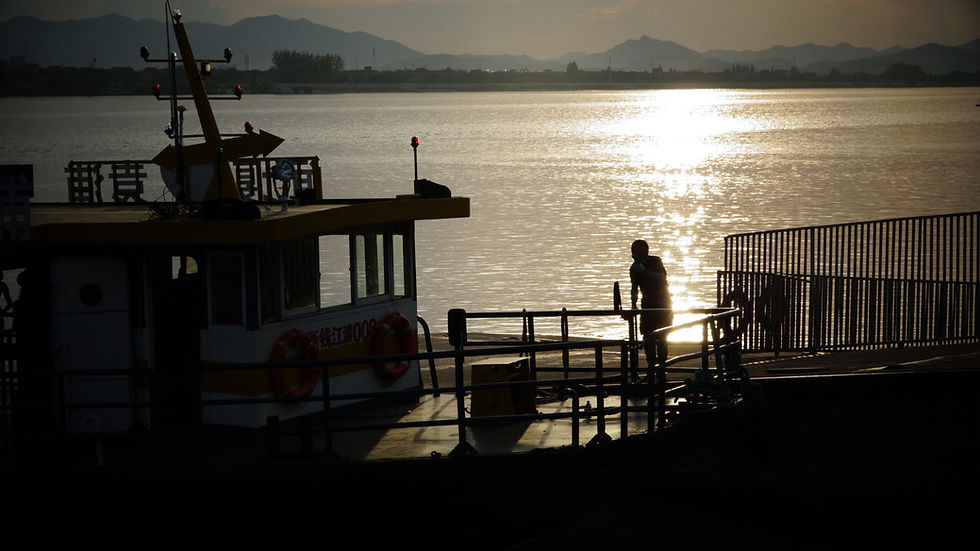
When I walked in, he was sorting through boxes of mineral water, his hands rough and sun-darkened. “Business is small,” he said with a smile, “but it keeps me busy.”
Li was born in a riverside village near Yuanpu. He grew up watching boats drift past his home long before there were bridges or highways. “In those days,” he said, “you couldn’t get anywhere without the ferry.” His father ran one of those ferries—a small wooden boat powered by two oars and sheer human strength. “I rowed with him sometimes,” Li recalled, “across the misty river in the early morning.”
When roads and bridges began to rise across Zhejiang, ferries became less necessary. The old men who once rowed passengers to work started to stay home, tending vegetables instead of boats. Li’s father was among them. But Li himself turned to cargo work. The 1990s brought a construction boom—real estate sites sprouting like bamboo shoots after rain, sand and gravel always in demand. “Back then, carrying sand was good money,” he said. “We delivered it to Hangzhou, Huzhou, even Shanghai and Jiangsu.”
Those were restless years. Sand dredgers roared across the river, barges lined the banks, and the Qiantang was alive with movement. But as development reached its peak and environmental restrictions tightened, dredging was banned, and the river’s commerce slowed. “There was less and less to carry,” Li said. “You couldn’t make a living from it anymore.”
So he joined a state-run passenger shipping company at Wulinmen Pier, working as a crewman on boats traveling to Jiande and Huzhou. “The pay was small, but it was easier,” he said. For a while, things were steady. Then came the highways, the high-speed rail, and the shrinking of river routes. By 2023, when the company restructured its lines, Li—one of the later hires—was laid off.
He was fifty-six then, with less than fifteen years of pension contributions. “Without fifteen years,” he explained, “you can’t collect social security. I’ll just keep paying until I turn sixty in 2027.” He said the town government offered little help for older boatmen like him. “Some places have better support,” he sighed, “but not here.”
Now he runs this tiny shop at the dock, earning just enough to keep his pension contributions going. “It’s not much, but it’s something,” he said. Some of his cousins and neighbors, younger and more daring, have taken loans to buy their own cargo boats. “It’s risky,” Li said, looking toward the river. “If business slows, you lose money—and husband and wife have to live on the boat all year. I’d rather stay here. It’s easier.”
When he said this, his eyes drifted to the water. The afternoon light caught the creases in his face, the long years of wind and tide carved into his skin.
The second time I passed by Wushan Dock, I saw him returning with new stock. His wife stood nearby, muttering something under her breath. I didn’t go in this time; it didn’t feel right to interrupt. From a distance, I watched them—two small figures framed by the wide river behind them; the tide still coming and going beyond the pier.
![Poem: "The Boatmen Community [A Neo-River Colony]"](https://static.wixstatic.com/media/929abe_e0b364e18dd743ce8092b77179359ff5~mv2.jpg/v1/fill/w_980,h_551,al_c,q_85,usm_0.66_1.00_0.01,enc_avif,quality_auto/929abe_e0b364e18dd743ce8092b77179359ff5~mv2.jpg)


Comments